
Endodontic

Root Canal Therapy

Save an infected or damaged tooth with gentle root canal treatment. We remove decay and bacteria, relieve pain, and restore your tooth to full function.
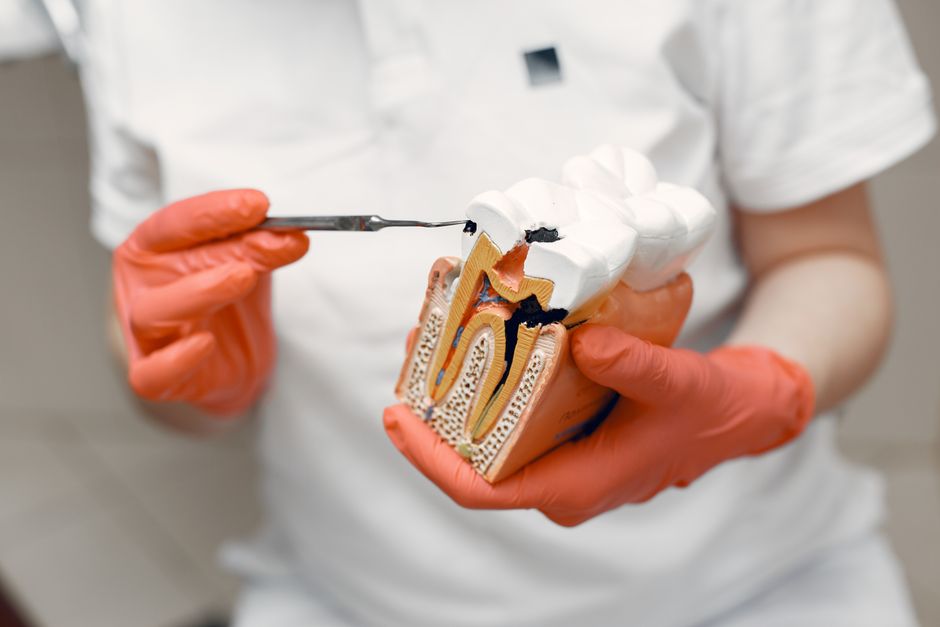
Close-up of dentist holding a tooth model, illustrating dental care concepts.

What Is Root Canal Therapy?

Root canal therapy is needed when the nerve of a tooth is affected by decay or infection. In order to save the tooth, the pulp (the living tissue inside the tooth), nerves, bacteria, and any decay are removed and the resulting space is filled with special, medicated dental materials, which restore the tooth to its full function.

Having a root canal done on a tooth is the treatment of choice to save a tooth that otherwise would die and have to be removed. Many patients believe that removing a tooth that has problems is the solution, but what is not realized is that extracting a tooth will ultimately be more costly and cause significant problems for adjacent teeth.

Root canal treatment is highly successful and usually lasts a lifetime, although on occasion, a tooth will have to be retreated due to new infections.


Signs and Symptoms for Possible Root Canal Therapy

  • An abscess or pimple on the gums
  • Sensitivity to hot and cold
  • Severe toothache pain
  • Sometimes no symptoms are present
  • Swelling and/or tenderness

Reasons for Root Canal Therapy

  • Decay has reached the tooth pulp (the living tissue inside the tooth)
  • Infection or abscess have developed inside the tooth or at the root tip
  • Injury or trauma to the tooth

What Does Root Canal Therapy Involve?

A root canal procedure requires one or more appointments and can be performed by a dentist or endodontist (a root canal specialist).

While the tooth is numb, a rubber dam (a sheet of rubber) will be placed around the tooth to keep it dry and free of saliva. An access opening is made on top of the tooth and a series of root canal files are placed into the opening, one at a time, removing the pulp, nerve tissue, and bacteria. If tooth decay is present, it will also be removed with special dental instruments.

Once the tooth is thoroughly cleaned, it will be sealed with either a permanent filling or, if additional appointments are needed, a temporary filling will be placed.

At the next appointment, usually a week later, the roots and the inside cavity of the tooth will be filled and sealed with special dental materials. A filling will be placed to cover the opening on top of the tooth. In addition, all teeth that have root canal treatment should have a crown (cap) placed. This will protect the tooth and prevent it from breaking, and restore it to its full function.

After treatment, your tooth may still be sensitive, but this will subside as the inflammation diminishes and the tooth has healed.


Aftercare

You will be given care instructions after each appointment. Good oral hygiene practices and regular dental visits will aid in the life of your root canal treatment.

How it works
01

Examination and Diagnosis

We examine your tooth and take X-rays to determine the extent of infection and whether root canal therapy is needed.

02

Numbing and Isolation

The tooth is numbed for your comfort, and a rubber dam is placed to keep the area clean and dry during treatment.

03

Cleaning and Shaping

We create an opening in the tooth and use specialized files to remove the infected pulp, nerves, and bacteria, then thoroughly clean the canals.

04

Filling and Sealing

The cleaned canals are filled with medicated dental materials and sealed. A temporary or permanent filling is placed.

05

Crown Placement

A crown is placed over the treated tooth to protect it from breaking and restore it to full function.

Common questions
Is root canal therapy painful?+

No. We numb the tooth completely before treatment, so you should feel no pain during the procedure. Most patients report that root canal therapy is no more uncomfortable than getting a filling. After treatment, you may have some sensitivity as the area heals, but this subsides quickly.

Why not just pull the tooth instead?+

Extracting a tooth may seem simpler, but it ultimately costs more and causes problems for adjacent teeth. When a tooth is removed, neighboring teeth can shift, and you may need a bridge or implant to fill the gap. Saving your natural tooth with root canal therapy is almost always the better choice.

How long does a root canal last?+

Root canal treatment is highly successful and usually lasts a lifetime. Occasionally, a tooth may need to be retreated due to new infections, but with good oral hygiene and regular dental visits, your treated tooth can serve you for many years.

Get in touch — Verona, NJ

Ready when you are — let's get you smiling.

New patients are always welcome. Give us a call, and we'll find a time that fits — gentle care, honest answers, no pressure.

  • No-pressure, unhurried first visit
  • We file your insurance for you
Call (973) 239-0032Contact us